
Cmore ("see more") is the fulfillment of the *more trilogy.
While Amore is the application for analyzing and documenting sounds, and Bmore the
allround toolbox for manipulating audio input and output streams,
Cmore is the versatile visualizer of audio data. All of these are independent processes, but work also well together: for example the audio output
streams from Bmore are fully accessible by both Amore and Cmore.
Four visualization modes are provided: waveform view, 2D spectrogram view, 3D spectrogram view, and the Visual Audio mode where a virtual room is lit with the
color of sound (audio spectrum -> light spectrum) that is coming out of the user-defined speaker set and is also visualized by 3D pressure waves.
By default Cmore uses Windows Audio Session API for capturing (with DirectSound as fallback), but for lower latencies you may wish to install ASIO drivers for your sound card. If none are available from your sound card manufacturer, try out ASIO4ALL (www.asio4all.com).
The two 3D modes are based on Direct3D 11 technology and require a high performance graphics card (min. GeForce 460 GTX / Radeon HD 6850 1GB) for smooth frame rates,
especially with stereoscopic 3D which is fully supported. Visual Audio mode has also a lighter Direct3D 9 implementation available for older systems.
Cmore is freeware and does not contain any spy- or adware. Get it here.
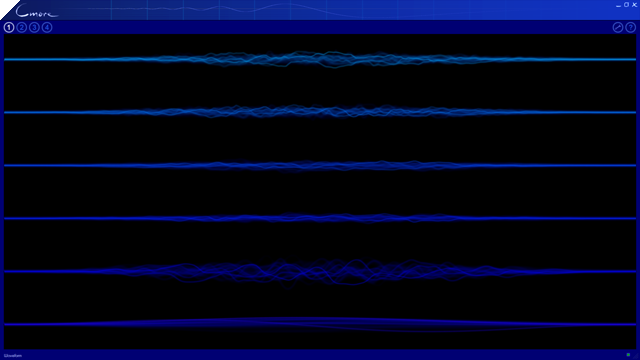 5.1 surround sound in waveform view.
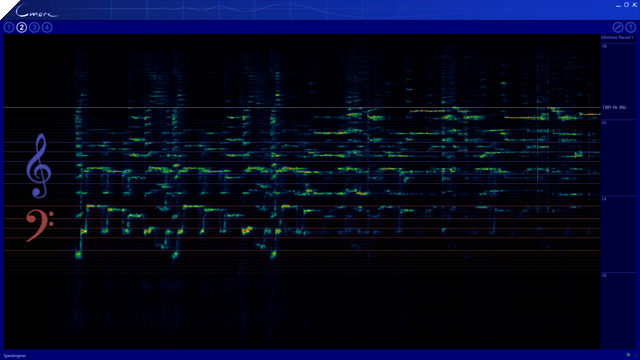 Spectrogram view with staves, here we have some acappella-singing going on.
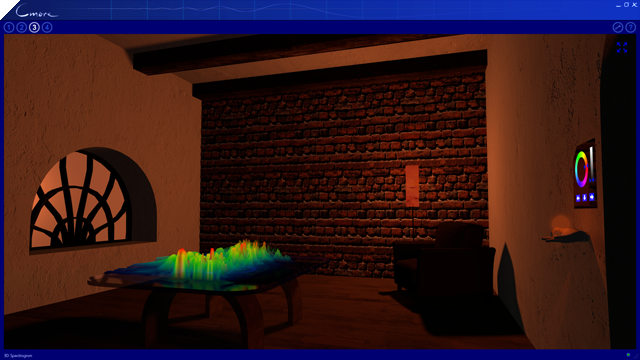 3D spectrogram in an interactive virtual room. Control panel on the right can be used for adjusting the hue
and brightness of the movable light. Brick wall rendering utilizes tesselation and displacement mapping.
Lighting model is based on forward shading, as deferred shading is somewhat problematic when it comes to transparency and antialiasing
(especially with stereo-3D).
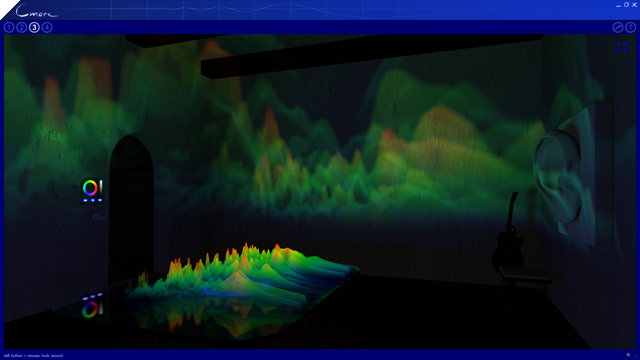 3D spectrogram from another angle. Lamp by the arm chair is turned off and the movable light is located inside the glass table,
casting a blueish atmosphere in the room. Translucent spectrogram is projected to roof and walls, and is seen in their reflections
on the table surface (in addition to the direct reflections).
3D spectrogram from another angle. Lamp by the arm chair is turned off and the movable light is located inside the glass table,
casting a blueish atmosphere in the room. Translucent spectrogram is projected to roof and walls, and is seen in their reflections
on the table surface (in addition to the direct reflections).
Dynamic soft shadows are tinted with the color of the semi-transparent materials through which the light has passed.
The width of the penumbra depends on the distance, and its rendering is based on pseudo-random averaging which allowed me
to ditch the typical variance shadow mapping approach and freed up texture space for transparency implementation.
Calculation of the cubic shadow maps utilizes the geometry shader.
Reflection textures use MSAA with 4, 8, 16 or 32 samples, depending on the capabilities of the graphics card.
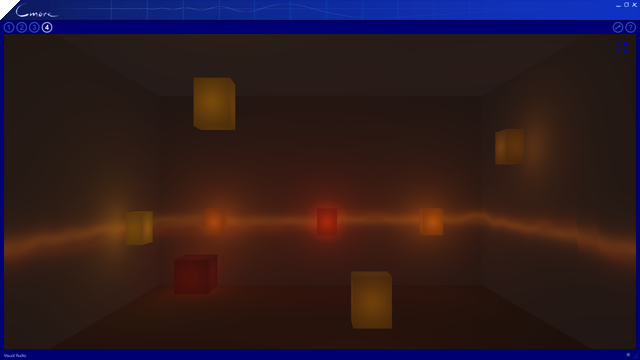 Visual Audio room with a 7.1 channel speaker set.
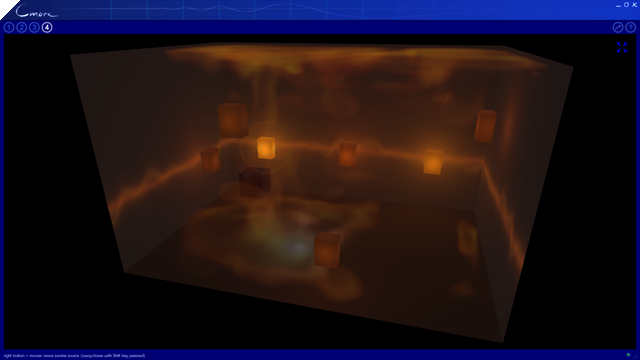 Visual Audion smoke simulation has 100*100*100 particles. Implementation is based on solving Navier-Stokes differential equations with the
MacCormack method using DirectX 11 compute shaders. Computational core is largely based on Jan Vlietinck's work.
Visualization of the smoke was first based on ray casting, but in order to support stereo-3D I implemented it with instanced camera-aligned
semi-transparent billboards on the correct depths along the view axis.
Visual Audion smoke simulation has 100*100*100 particles. Implementation is based on solving Navier-Stokes differential equations with the
MacCormack method using DirectX 11 compute shaders. Computational core is largely based on Jan Vlietinck's work.
Visualization of the smoke was first based on ray casting, but in order to support stereo-3D I implemented it with instanced camera-aligned
semi-transparent billboards on the correct depths along the view axis.
Cmore is the versatile visualizer of audio data. All of these are independent processes, but work also well together: for example the audio output streams from Bmore are fully accessible by both Amore and Cmore.
Four visualization modes are provided: waveform view, 2D spectrogram view, 3D spectrogram view, and the Visual Audio mode where a virtual room is lit with the color of sound (audio spectrum -> light spectrum) that is coming out of the user-defined speaker set and is also visualized by 3D pressure waves.
By default Cmore uses Windows Audio Session API for capturing (with DirectSound as fallback), but for lower latencies you may wish to install ASIO drivers for your sound card. If none are available from your sound card manufacturer, try out ASIO4ALL (www.asio4all.com). The two 3D modes are based on Direct3D 11 technology and require a high performance graphics card (min. GeForce 460 GTX / Radeon HD 6850 1GB) for smooth frame rates, especially with stereoscopic 3D which is fully supported. Visual Audio mode has also a lighter Direct3D 9 implementation available for older systems.
Cmore is freeware and does not contain any spy- or adware. Get it here.
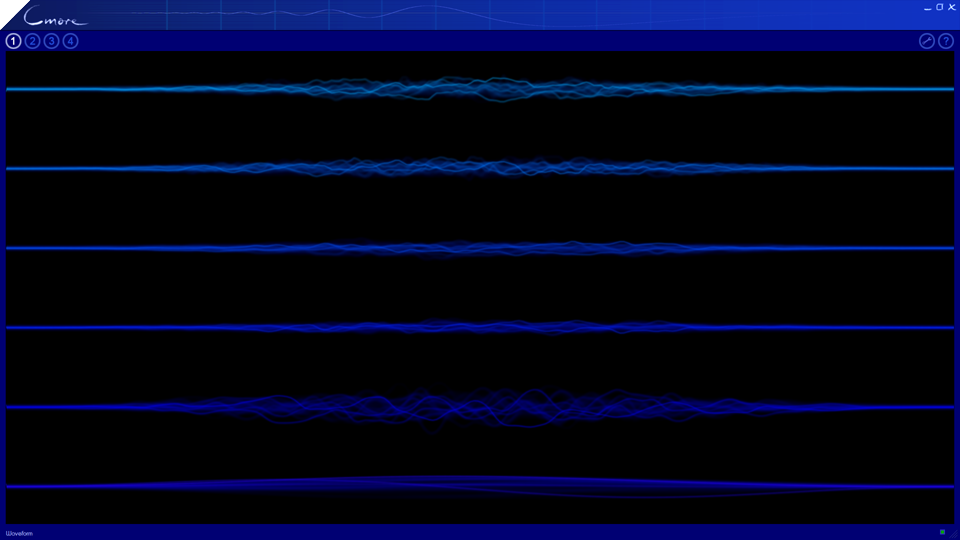 5.1 surround sound in waveform view.
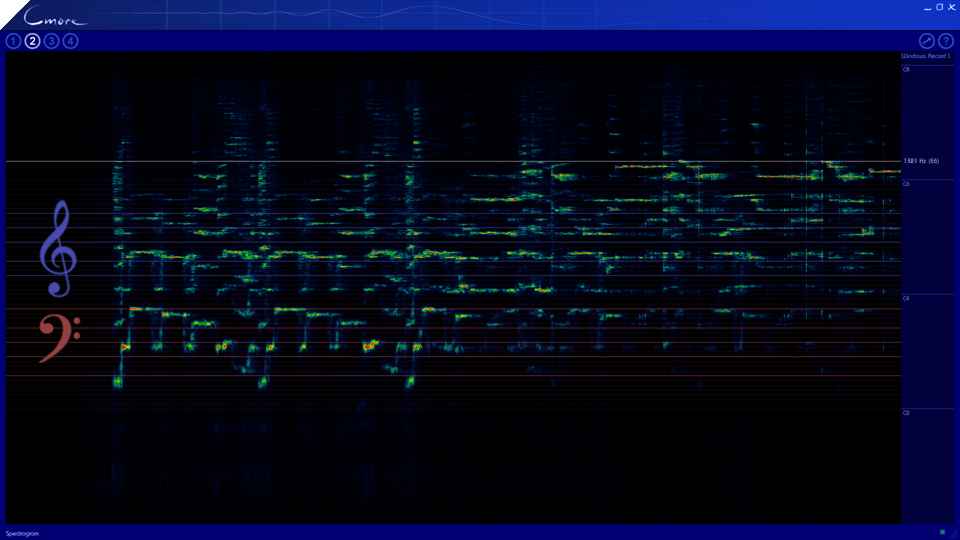 Spectrogram view with staves, here we have some acappella-singing going on.
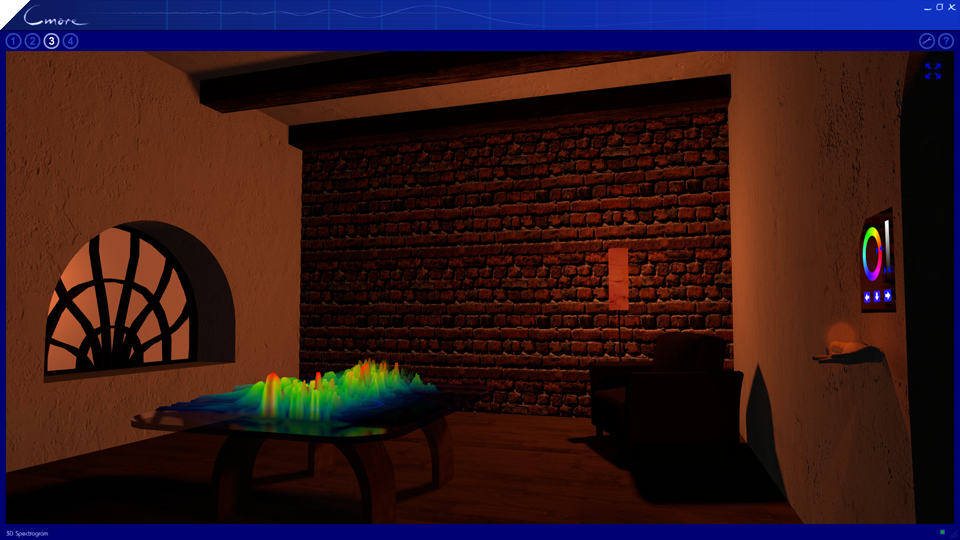 3D spectrogram in an interactive virtual room. Control panel on the right can be used for adjusting the hue
and brightness of the movable light. Brick wall rendering utilizes tesselation and displacement mapping. Lighting model is based on forward shading, as deferred shading is somewhat problematic when it comes to transparency and antialiasing (especially with stereo-3D).
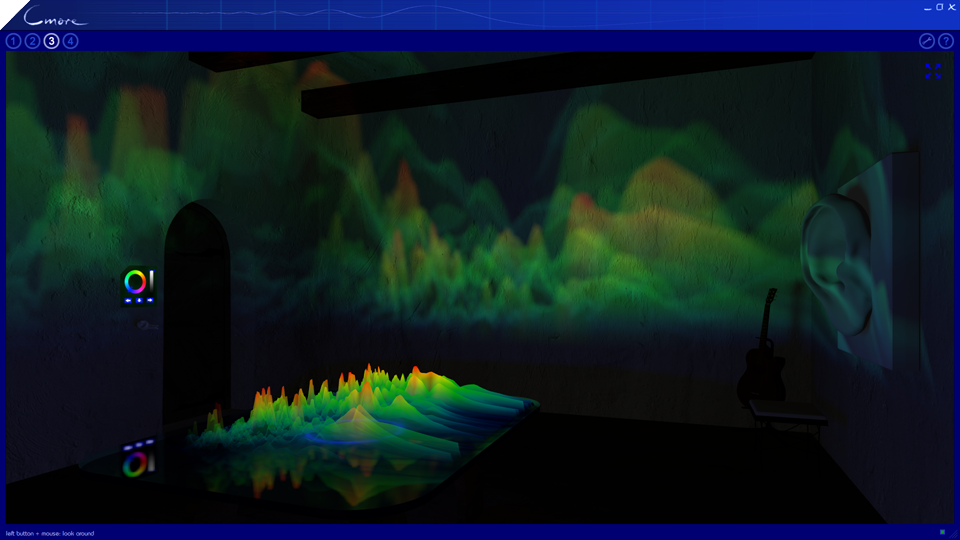 3D spectrogram from another angle. Lamp by the arm chair is turned off and the movable light is located inside the glass table,
casting a blueish atmosphere in the room. Translucent spectrogram is projected to roof and walls, and is seen in their reflections
on the table surface (in addition to the direct reflections).
3D spectrogram from another angle. Lamp by the arm chair is turned off and the movable light is located inside the glass table,
casting a blueish atmosphere in the room. Translucent spectrogram is projected to roof and walls, and is seen in their reflections
on the table surface (in addition to the direct reflections).Dynamic soft shadows are tinted with the color of the semi-transparent materials through which the light has passed. The width of the penumbra depends on the distance, and its rendering is based on pseudo-random averaging which allowed me to ditch the typical variance shadow mapping approach and freed up texture space for transparency implementation. Calculation of the cubic shadow maps utilizes the geometry shader. Reflection textures use MSAA with 4, 8, 16 or 32 samples, depending on the capabilities of the graphics card.
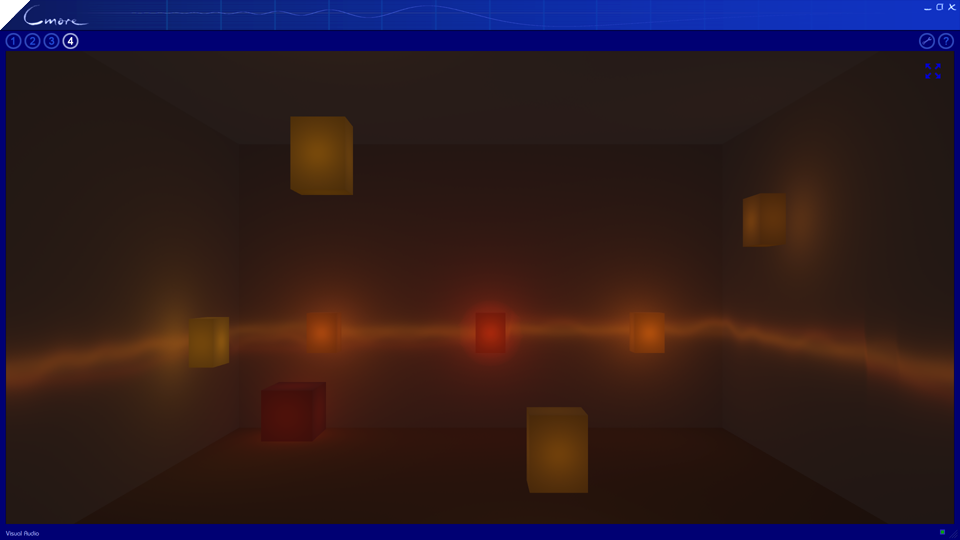 Visual Audio room with a 7.1 channel speaker set.
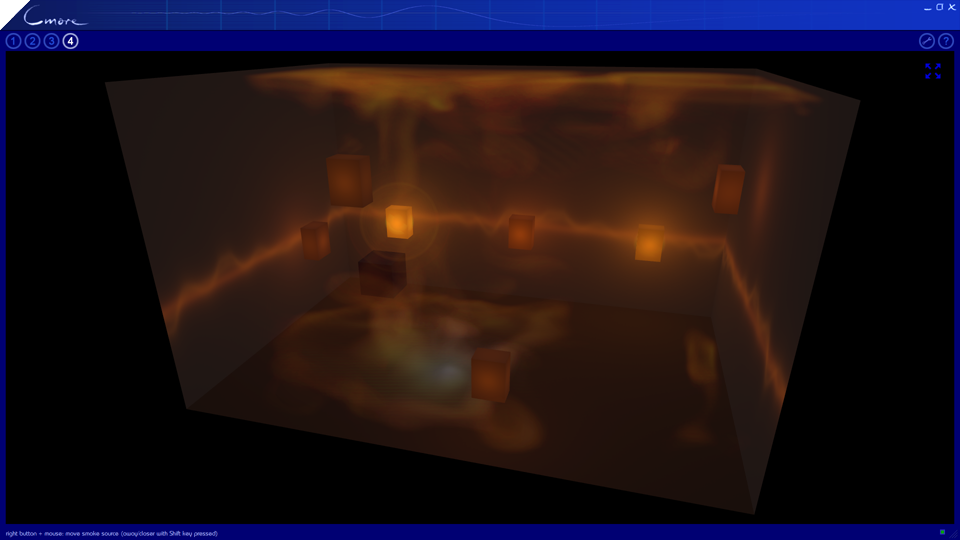 Visual Audion smoke simulation has 100*100*100 particles. Implementation is based on solving Navier-Stokes differential equations with the
MacCormack method using DirectX 11 compute shaders. Computational core is largely based on Jan Vlietinck's work.
Visualization of the smoke was first based on ray casting, but in order to support stereo-3D I implemented it with instanced camera-aligned
semi-transparent billboards on the correct depths along the view axis.
Visual Audion smoke simulation has 100*100*100 particles. Implementation is based on solving Navier-Stokes differential equations with the
MacCormack method using DirectX 11 compute shaders. Computational core is largely based on Jan Vlietinck's work.
Visualization of the smoke was first based on ray casting, but in order to support stereo-3D I implemented it with instanced camera-aligned
semi-transparent billboards on the correct depths along the view axis.